
"After the devastating frost of 1956, olive oil became a rare and expensive product in much of southern France. We believed there was another way..."
Nestled at the crossroads of Provence, Languedoc, and the Camargue, Château de Montfrin is one of France’s most innovative olive oil producers, combining large-scale organic farming with an uncompromising commitment to quality. While the estate has deep agricultural roots dating back generations, it has become a pioneer in modern French olive cultivation, proving that exceptional extra virgin olive oil can be both sustainable and accessible.
The story began in 1995, when Jean René de Fleurieu planted the estate’s first olive grove. At a time when traditional low-density orchards dominated French olive production, he became the first producer in France to embrace high-density planting. Defying conventional wisdom and the restrictions of regional appellation systems, he believed this approach offered the best opportunity to produce consistently high-quality olive oil on a larger scale.
The de Fleurieu family has lived in Montfrin since the 1920s, farming grapes, potatoes, cereals, cherries, and other crops across the fertile Rhône Valley. Olive oil became the estate's primary focus in the 1990s, and in 1999 the family installed its own olive mill, allowing complete control over production from grove to bottle. Together with Benjamin Béguin, who joined the estate in the early 2000s, Château de Montfrin evolved into a highly efficient agricultural operation where olive oil and wine production work hand in hand, sharing equipment, expertise, and a common philosophy centered on quality and sustainability.
Today, the estate produces certified organic extra virgin olive oil and organic wines while continuing to expand its olive groves and refine its production methods. With more than 250,000 olive trees, Château de Montfrin has become one of France's largest organic olive oil estates and a leading example of modern French olive growing.

The Terroir
Château de Montfrin is located in southern France, between the historic cities of Nîmes, Arles, and Avignon, where the landscapes of Provence and Languedoc meet the wetlands of the Camargue.
For centuries, this region has been one of France's most productive agricultural areas. Vineyards, apricot and peach orchards, olive groves, and cereal fields have long defined the countryside, benefiting from abundant sunshine, Mediterranean temperatures, and fertile soils.
The estate's olive groves are planted at approximately 69 meters above sea level on ancient Rhône River pebble beds. These mineral-rich soils provide excellent drainage while encouraging healthy root development. Because rainfall alone cannot sustain production, the groves are supported by carefully managed irrigation, made possible through reliable access to water resources.
The famous Mistral, the powerful northern wind that sweeps across southern France, plays an equally important role. By reducing humidity around the trees, it naturally limits disease pressure while contributing to the balanced, expressive character of the oils.
Today, Château de Montfrin cultivates approximately 250,000 olive trees across 160 hectares of organic orchards. Although the estate originally planted fifteen different olive varieties, experience has led the team to focus on six cultivars that consistently deliver the best quality under local growing conditions.
Together, the Rhône soils, Mediterranean climate, irrigation, and persistent Mistral create olive oils known for their freshness, balance, and distinctive regional identity.

The Harvest
Harvest at Château de Montfrin begins each year in early October, immediately following the grape harvest.
Because the estate produces both wine and olive oil, the same harvesting machinery is used for both crops. After the grape harvest concludes, the equipment undergoes several days of maintenance before being adapted for olive harvesting, allowing the team to move efficiently from vineyards to olive groves.
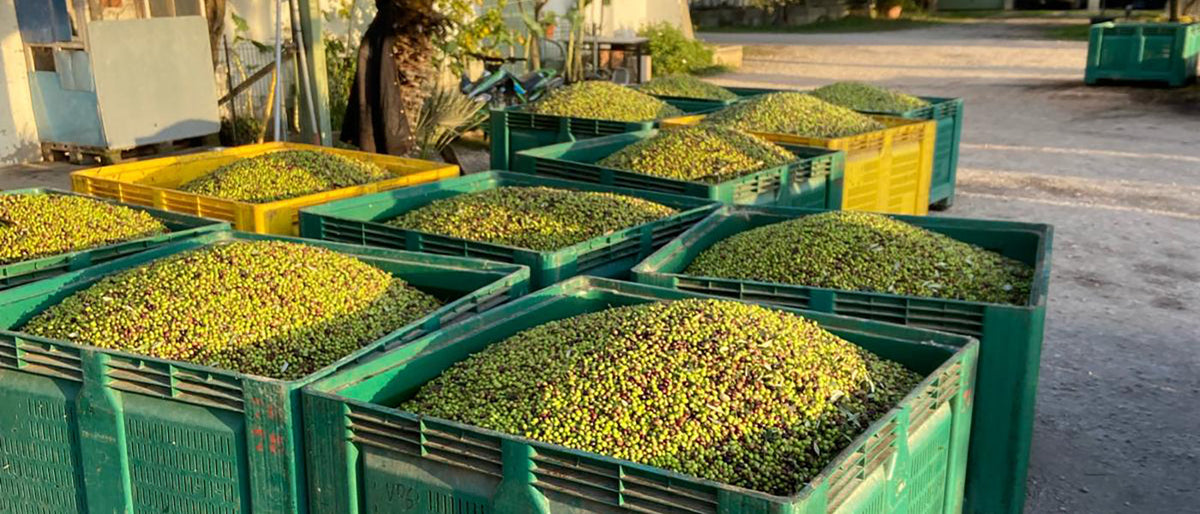
Most of the estate's 160 hectares are harvested mechanically using tractor-mounted equipment that has been operated by Antonio, the estate's dedicated machine operator, for more than two decades. Only a small traditional Picholine grove, planted during the 1960s, continues to be harvested by hand with the help of seasonal workers.
The olives are harvested when they are beginning to change color, transitioning from bright green to the first shades of purple during veraison. At this stage, they offer the ideal balance between freshness, aromatic intensity, and polyphenol concentration.
The estate produces an average of 110,000 liters of organic extra virgin olive oil each year, with exceptional harvests reaching as much as 180,000 liters.

Production & Innovation
Innovation has defined Château de Montfrin since its earliest days.
When Jean René de Fleurieu introduced high-density olive cultivation in France, the decision represented a radical departure from traditional production methods. His vision was simple: mechanization would make it possible to produce outstanding extra virgin olive oil efficiently enough to remain affordable for French consumers.
The estate's olive mill, installed in 1999, allows every stage of production to be carefully monitored without leaving the property. Olives are processed using metal-toothed grinders, followed by an advanced dual-phase centrifugal extraction system, preserving freshness while minimizing waste.
Producing organic olive oil at this scale presents unique challenges. High-density orchards were not originally designed for organic cultivation, requiring constant innovation in orchard management and sustainable farming practices. Nevertheless, the estate remains committed to certified organic production while continually refining its techniques.
Looking ahead, Château de Montfrin continues to expand its olive groves and production capacity. As France's olive oil sector evolves and new producers enter the market, the estate's objective remains straightforward: to continue improving quality while demonstrating that large-scale, organic extra virgin olive oil can remain true to its terroir and accessible to consumers.

The People Behind the Oil
Behind Château de Montfrin is a family that has spent generations working the land, continually adapting while remaining deeply rooted in agriculture.
Jean René de Fleurieu brought an unconventional perspective to olive growing, having previously worked in both agriculture and film production before turning his attention to olives. Together with Benjamin Béguin, he transformed the estate into an integrated operation where wine and olive oil production complement one another through shared expertise and infrastructure.
Their greatest motivation has always been to make outstanding organic olive oil available to more people. Following the devastating frost of 1956, olive oil production in much of southern France shifted toward small-scale, expensive production. Château de Montfrin sought a different path—using modern cultivation methods to produce exceptional quality while maintaining affordability.
The estate continues to pursue that vision today, guided by continual improvement and respect for the land. Every harvest presents new challenges, particularly as climate conditions become increasingly unpredictable, but the team remains focused on refining their craft and producing the finest organic olive oils possible.
"After the devastating frost of 1956, olive oil became a rare and expensive product in much of southern France. We believed there was another way—to produce outstanding organic olive oil that remained both accessible and true to its origins. That vision continues to guide everything we do today."
Jean René de Fleurieu

Enquiries
For trade, wholesale, or hospitality enquiries, please contact the producer directly through their official channels.


