“Our ultimate inspiration is to see Mandranova as a community of everyone who contributes to its success, moving beyond the concept of a simple family farm.”
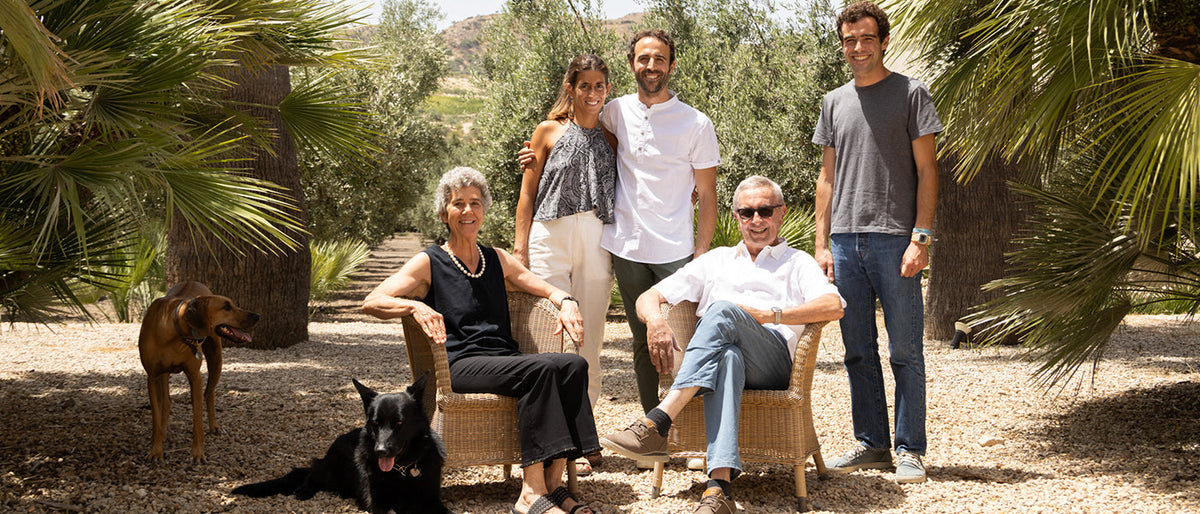
Mandranova is a sixth-generation family estate on the southern coast of Sicily, where olive cultivation has been part of the family’s economic life for generations. Today, Silvia and Giuseppe lead the estate, bringing together deep agricultural heritage with a modern vision centered on quality, hospitality, and the continued renewal of the farm.
While Mandranova has always been part of the family’s activities, Silvia and Giuseppe chose to dedicate themselves fully to the estate in the late 1990s, following careers in other sectors. They planted a new olive grove, restored the estate’s main house, and began transforming Mandranova into the modern agricultural estate it is today. In 2002, they added their own frantoio, bringing olive oil extraction directly to the farm.

The estate is located near Palma di Montechiaro, on Sicily’s southern coast, an area shaped by centuries of cultural exchange. Greeks, Arabs, and Spanish have all influenced the island, leaving behind a rich mixture of traditions, architecture, agriculture, and cuisine. The nearby town of Palma di Montechiaro is also closely associated with Christian pilgrimage and is famously connected to Giuseppe Tomasi di Lampedusa’s The Leopard.
Today, Mandranova is evolving beyond the idea of a traditional family farm. Silvia and Giuseppe envision the estate as a community made up of everyone who contributes to its success, while maintaining a strong connection to the land and to the agricultural traditions that have shaped their family for generations.
For Mandranova, olive oil represents both a continuation of the past and an opportunity to build something for the future—preserving the character of a historic Sicilian estate while continually investing in its land, people, and production.

The Terroir
Mandranova is situated along the southern coast of Sicily, with its olive groves extending from approximately 90 to 220 meters above sea level.
Sicily’s warm Mediterranean climate creates naturally intense conditions for olive cultivation. Abundant sunshine and warm temperatures encourage the development of flavorful fruit, while controlled irrigation during the summer helps the trees maintain healthy growth and produce well-developed olives.
The estate is home to approximately 9,000 olive trees planted in 1994 and 1995, alongside several hundred centuries-old trees that connect the modern farm with the agricultural landscape of the past.

Mandranova is also in the midst of a long-term renewal of its groves. In 2025, the family planted another 4,500 olive trees, with plans to plant a further 4,500 between 2027 and 2028. This forms part of a project that began in 1994 to gradually replace lower-value crops with traditional, higher-value products that are closely connected to the identity of the estate.
The family cultivates five olive varieties: Nocellara, Biancolilla, Cerasuola, Giarraffa, and Coratina.
Each variety brings its own characteristics to the estate’s production, while the combination of Sicilian varieties and the warm coastal environment contributes to oils with the intensity and character associated with the island.
Beyond olives, Mandranova also grows Sicilian almonds, another traditional crop that forms an increasingly important part of the farm’s future.

The Harvest
Harvest at Mandranova typically begins in mid-September, making it one of the earliest stages of the olive harvest season.
Most of the estate’s varieties are harvested while still green, when the fruit is at an early stage of ripeness. Cerasuola is the exception, developing distinctive black and purple coloration as it matures.
The harvest combines traditional skills with modern equipment. Mandranova’s team uses hand-held pneumatic combs for much of the harvesting, alongside tractor-mounted shakers. This combination allows the estate to work efficiently while maintaining careful control over the fruit.

Once harvested, the olives are brought directly to the estate’s frantoio for processing. Keeping the process close to the grove allows Mandranova to move efficiently from tree to mill and begin extraction while the fruit is fresh.
The harvest is carried out by Mandranova’s team of fourteen colleagues, making it a collective effort that brings together the people responsible for the farm throughout the year.
In an average year, Mandranova produces more than 200 tons of olive oil. The estate has storage capacity for up to 65,000 liters, although the family notes that this maximum has never yet been reached.

Production & Innovation
Mandranova’s approach to production combines modern milling technology with an understanding of the individual characteristics of each olive variety.
After harvesting, the olives are crushed using hammermills or metal-toothed grinders, with the equipment selected according to the variety and its stage of ripeness. This flexibility allows the milling process to be adapted to the fruit rather than applying exactly the same approach to every olive.
The resulting paste is processed through a two-phase centrifugal decanter, separating the oil from the solid and liquid components of the fruit while allowing Mandranova to work efficiently with freshly harvested olives.

The family’s commitment to quality extends beyond the mill. Maintaining consistently high quality is one of the greatest challenges they face as producers, particularly because the scale of production is ultimately limited by the number of trees on the estate.
Rather than pursuing unlimited expansion, Mandranova is focused on gradually increasing the proportion of the farm dedicated to high-value traditional crops. The long-term plan is to concentrate exclusively on olives and almonds, while continuing to invest in improved machinery for processing both.
The family is also continually exploring new solutions that can further improve the quality of its products, ensuring that Mandranova continues to evolve while remaining grounded in its agricultural heritage.

The People Behind the Oil
At the heart of Mandranova are Silvia and Giuseppe, the sixth generation of their family to be connected to the estate.
After initially pursuing careers outside agriculture, they returned to the family farm in the late 1990s and chose to dedicate themselves to its future. Their work has transformed Mandranova from a traditional family agricultural operation into a modern estate with its own olive mill, hospitality, and a growing focus on high-value Sicilian products.
Today, they work alongside a team of fourteen colleagues who contribute to the daily life of the farm and the annual olive harvest.
For Silvia and Giuseppe, the most rewarding part of producing olive oil is the connection between farming and a product with such a long-standing social and economic importance. Their greatest inspiration, however, extends beyond the olive oil itself.
They hope to see Mandranova develop into a community of everyone who contributes to its success, moving beyond the concept of simply being a family farm.
That philosophy is reflected in the estate’s long-term approach: preserving centuries of family connection to the land while investing in new trees, new equipment, and new ways of improving the products that come from it.
“Our ultimate inspiration is to see Mandranova as a community of everyone who contributes to its success, moving beyond the concept of a simple family farm.”
Silvia & Giuseppe, Mandranova

Enquiries
For trade, wholesale, or hospitality enquiries, please contact Olive Oil Lovers or Mandranova through their official channels.